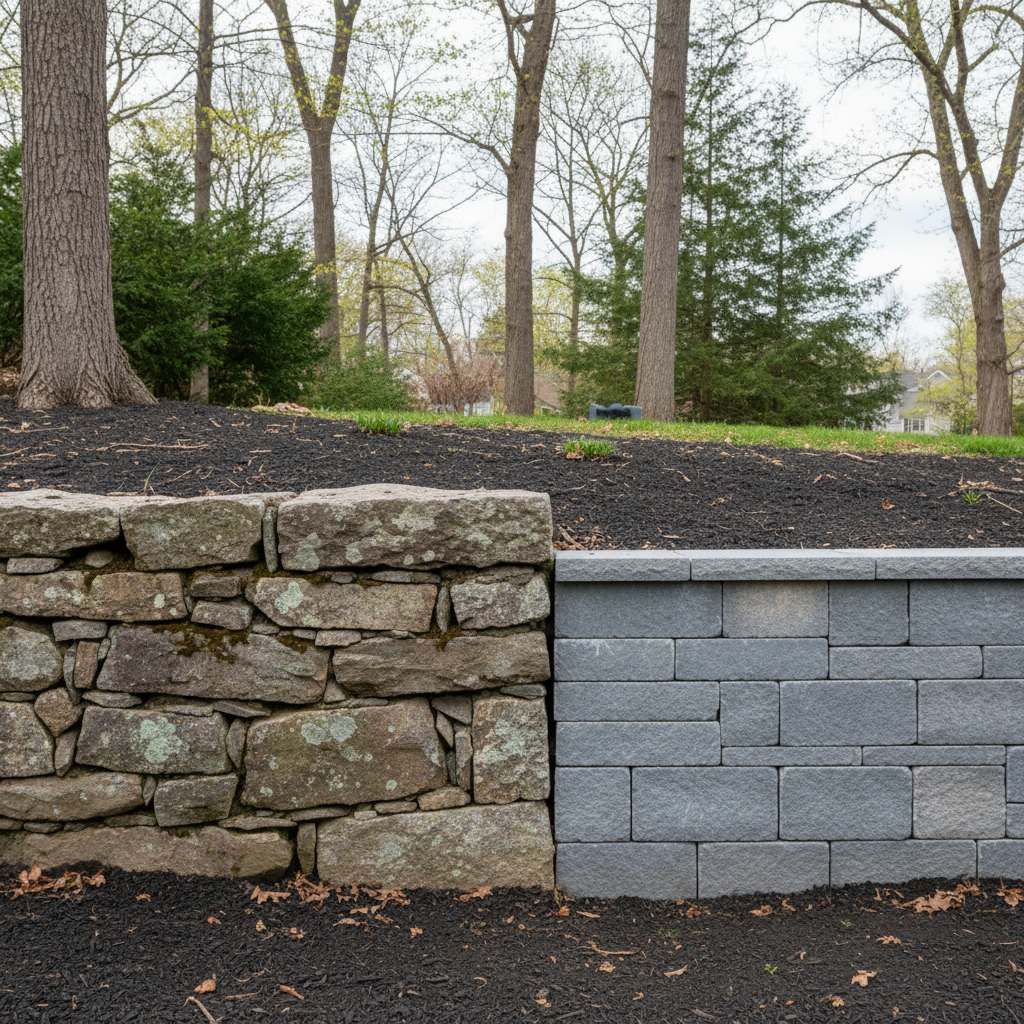
Are you staring at a sloping backyard near Weston Road and trying to figure out what kind of natural stone retaining wall will actually hold that slope back? Property owners around here generally have two choices when building with natural stone: dry laid stone walls or mortared stone walls. Both options look incredible when they are done right, but they behave completely differently once our Wellesley winters start getting cold.
Let us talk about dry laid stone walls first. This is the old-school way of building a natural stone wall. No mortar holds the rocks together. Instead, it is all about physics, gravity, and a mason who knows how to puzzle pieces together so they lock tight. Valley Masonry Co. loves dry laid stone walls for landscape features, garden terraces, and lower retaining walls. They have a rustic charm that fits right in with older colonials and Victorians.
The biggest perk of a dry laid stone wall is drainage. Water does not trap behind the stones because it just flows right through the gaps. Here in New England, trapped water is the enemy. When temperatures drop below freezing, trapped water turns to ice, expands, and pushes walls apart. Dry laid stone walls naturally dodge this issue. If the ground shifts a tiny bit during a spring thaw, the dry laid stone wall rolls with the movement instead of cracking in half.
Mortared stone walls, on the other hand, use cement mortar to lock every stone into a rigid structure. You will see these a lot on formal patios, grand entrance pillars, or structural retaining walls holding up steep driveways. They look crisp, clean, and intentional. They also let you use thinner stones or irregular shapes that would not stack safely on their own without bonding agents.
How Costs and Maintenance Stack Up
Homeowners always ask Valley Masonry Co. which option costs more. Upfront, a dry laid stone wall usually takes more labor hours. You need an artisan who spends extra time shaping and fitting stones so they are stable without any bonding agents. Mortared stone walls go up faster, but you are paying for materials and precise formwork. Over time, though, maintenance tells a different story.
A mortared stone wall looks great for years, but eventually, New England freeze-thaw cycles will crack the mortar joints. Water gets into tiny hair-line cracks, freezes, and pops chunks out. You will be looking at repointing sections every few years to keep water out. At Valley Masonry Co., we fix these cracked joints all spring long.
Dry laid stone walls do not need repointing because there is no mortar to fail. If a stone gets kicked loose by a snowplow or a falling tree branch, you can often pop it right back in. But if a dry laid stone wall suffers a major structural blowout from poor drainage or shifting clay soil, rebuilding that section requires serious skill.
Which One Belongs on Your Property?
If you are building a structural retaining wall over three feet high, go with a mortared stone wall backed by a concrete block core. You need that heavy-duty strength to hold back tons of wet Wellesley soil, especially after a heavy Nor'easter dumps inches of rain. But if you are putting in a low decorative wall along your front walkway or edging a garden bed, build it dry laid.
Think about the overall style of your house and how you want to maintain it. If you hate the idea of scraping out crumbling cement down the road, go mortar-free for your landscape features. Either way, make sure your base prep is deep and packed with crushed stone. Without a solid crushed-stone trench underneath, neither natural stone wall style will survive a single winter.